Breaking The Bottleneck: Practical Ways To Fix Warehouse Congestion
January 20, 2026

Warehouse congestion slows operations, increases costs, and creates safety risks for workers. As order volumes grow and fulfillment timelines shrink, crowded aisles, dock backups, and staging area overflow become more common. Addressing congestion requires a clear look at how space, labor, and processes interact throughout the facility.
Key Takeaways on Fixing Warehouse Congestion
- Identify Specific Bottlenecks: Before making changes, use data on order volumes and dwell times to pinpoint the exact areas where congestion starts, such as receiving docks or picking paths. This ensures you focus your efforts where they matter most.
- Reassess Your Layout and Slotting: Your warehouse layout should match your current inventory and order profiles. Place fast-moving items closer to packing stations and consider widening high-traffic aisles to improve the flow of people and equipment.
- Improve Dock and Yard Management: Implement a structured appointment schedule for inbound and outbound lorries. This prevents queues and keeps your staging areas clear, ensuring a smooth transition of goods.
- Balance Your Workforce and Equipment: Ensure your staffing levels and equipment availability align with your workload peaks. Assigning roles based on real-time demand prevents too many workers from crowding one area and causing a slowdown.
- Use Technology for Better Visibility: Employ a Warehouse Management System (WMS) to direct picking routes and monitor activity in real time. Tools like this help you anticipate and resolve potential congestion before it escalates.
- Standardise Your Processes: Create clear, consistent procedures for all warehouse tasks. When your team is well-trained on standard processes, they can work more confidently and efficiently, reducing the errors and rework that lead to delays.
Register Your LLC
Company Registration
START NOW
Identify Where Congestion Starts
Congestion rarely affects an entire warehouse evenly. It usually forms at specific pressure points such as receiving docks, pick paths, or packing stations. High traffic zones often result from poor layout decisions or outdated workflows that no longer match order profiles.
Data from order volumes, dwell times, and equipment usage can reveal where slowdowns occur. Understanding these patterns helps leaders focus on improvements where they will deliver the most impact rather than making broad changes that disrupt operations.
Reevaluate Layout and Slotting
Warehouse layouts often remain unchanged long after inventory mixes and order volumes shift. Aisles that once worked well can become chokepoints as product velocity increases. Adjusting slotting strategies places fast-moving items closer to packing areas and reduces unnecessary travel.
Widening high traffic aisles, separating pedestrian and equipment routes, and relocating staging zones can significantly ease congestion. Even small layout changes can improve flow if they reduce crossing paths and idle time.
Improve Dock Scheduling and Yard Flow
Inbound and outbound congestion frequently begins at the dock. Poorly timed arrivals lead to truck queues, overcrowded staging areas, and rushed unloading. Structured appointment scheduling spreads activity more evenly across shifts and prevents surges.
Coordinating yard operations ensures trailers are staged and moved efficiently. Clear communication between carriers and dock teams reduces wait times and keeps freight moving without unnecessary handling.
Balance Labor and Equipment
Congestion increases when labor and equipment availability do not align with workload peaks. Too many workers in a limited area can be as problematic as too few. Assigning roles based on real-time demand prevents clustering at popular zones.
Equipment such as forklifts and pallet jacks should be distributed based on task priority. Preventive maintenance also matters. Equipment breakdowns often create unexpected bottlenecks that ripple across the facility.
Use Technology to Support Flow
Technology plays a growing role in managing warehouse movement. Warehouse management systems help direct picking routes and allocate tasks dynamically. When paired with transportation management software, outbound scheduling and carrier coordination improve, reducing dock congestion and trailer dwell time.
Visibility tools allow managers to monitor activity as it happens. This makes it easier to adjust staffing or reroute work before congestion escalates into delays.
Standardize Processes and Train Teams
Inconsistent processes increase congestion by creating confusion and rework. Clear standards for receiving, picking, and packing help teams move with confidence. Training ensures workers understand not just what to do, but where and when to do it.
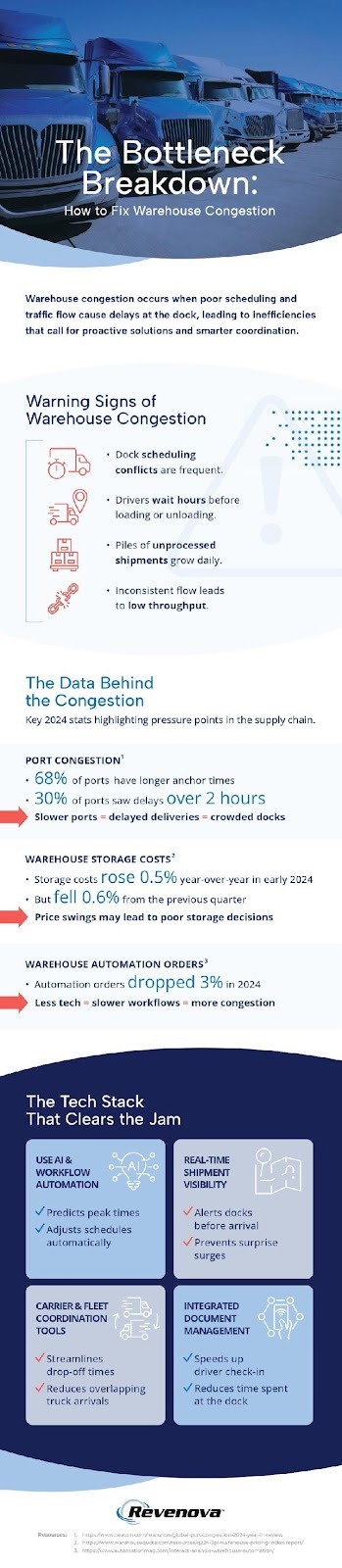
Warehouse congestion is rarely solved by one change. It improves through a combination of layout adjustments, smarter scheduling, balanced staffing, and better visibility. Addressing these areas together creates smoother flow, safer operations, and a facility that can scale without gridlock. Check out the infographic below to learn more.
FAQs for Breaking The Bottleneck: Practical Ways To Fix Warehouse Congestion
What is the first step to solving warehouse congestion?
Your first step should be to identify exactly where the problems are. Instead of guessing, use data from your operations to find the specific pressure points, like a crowded packing station or a backed-up receiving dock. This allows you to target the root cause directly.
How does an outdated warehouse layout cause bottlenecks?
A layout that no longer matches your inventory mix or order volume can create significant congestion. Aisles may become too narrow for current traffic, or fast-selling items might be stored far from shipping areas, causing unnecessary travel and crowding along the way.
Can technology really help reduce warehouse congestion?
Yes, absolutely. A Warehouse Management System (WMS) can create more efficient picking routes and allocate tasks to prevent staff from clustering in one area. Visibility tools give you a real-time view of operations, so you can adjust plans before a bottleneck even forms.
Why is staff training important for managing warehouse flow?
Consistent processes are key to a smooth operation. When your team is properly trained on standardised procedures for receiving, picking, and packing, there is less confusion and rework. Everyone knows their role, which helps maintain a steady and efficient workflow.